Spring 2027 course announcement An advanced course for undergraduate and graduate students
The Independence Property of Model TheoryA Mathematical Rosetta Stone
Instructor: José Iovino
Research assistant: Olivia Aubone
A limit of continuous functions need not be continuous. We follow restrictions on independent patterns that connect this familiar fact to probability, symmetry, dynamics, quantum measurement, and computation.
Ask about the course Printable flyer with QR code (PDF)A mathematical Rosetta Stone
Follow a translation.
Select a subject to see what the tests and witnesses become. Each branch gives a mathematical reading of prescribed values at a common input.
Limits and
independence
Several mathematical readings
Model theory
Truth patterns for one formula
- The tests
- The tests are instances of one fixed formula, with the object tuple chosen in finitely many ways.
- The witness
- A parameter tuple gives the truth values of those instances.
The independence property permits every truth pattern on arbitrarily large finite families of instances. Its absence is NIP. This reading is optional and assumes the language of a first course in model theory.
Continue to the role of model theoryTopology
Pointwise closures of functions
- The tests
- The tests are continuous real functions, with fixed separated low and high thresholds.
- The witness
- A point in their common domain realizes the prescribed inequalities.
For a countable pointwise bounded family on a compact metrizable space, excluding an infinite independent sequence gives a Rosenthal compact closure and sequential access to its points through BFT.
Continue at step 01: Pointwise closures and finite patternsProbability
Uniform control from finite samples
- The tests
- The tests ask whether a sample point belongs to a member of a family of measurable sets.
- The witness
- A sample point records a membership pattern. Shattering reverses the viewpoint: a set is chosen to prescribe membership on the sample.
Finite VC dimension bounds the number of traces by a polynomial and, under the usual measurability hypotheses, gives uniform estimation of probabilities from independent samples.
Continue at step 01: Pointwise closures and finite patternsCombinatorics
Every subset, or a polynomial bound
- The tests
- Fix finitely many points. The tests ask whether a chosen set contains each point.
- The witness
- A set in the family realizes one subset of those points.
Shattering means that all subsets occur. The Sauer–Shelah theorem bounds the number of traces on n points by the sum of the first d + 1 binomial coefficients when the VC dimension is at most d.
Continue at step 01: Pointwise closures and finite patternsBanach geometry
Independence becomes a norm estimate
- The tests
- Vectors in a bounded sequence are evaluated by functionals in the dual unit ball.
- The witness
- A bounded linear functional prescribes separated low and high values on selected vectors.
For real Banach spaces, the infinite independent configuration yields an ℓ₁ lower estimate. Rosenthal’s theorem gives the alternative: an ℓ₁ subsequence or a weakly Cauchy subsequence.
Continue at step 02: Sequences, symmetry, and classical subspacesDynamics
A prescription along one orbit
- The tests
- One continuous observation is read at selected iteration times.
- The witness
- An initial state realizes the low–high itinerary along its orbit.
A compact metrizable cascade is tame when no continuous observation has an independent sequence of iterates. Its limiting transformations are then of the first Baire class.
Continue at step 03: Limits become operationsComputation
The same Newton update on two domains
- The tests
- For N(z) = (z + 1/z)/2, read the bounded real observation 2(Re z + Im z)/(1 + |z|²), with value zero at infinity.
- The witness
- The witness is a real or complex initial input. Zero and infinity are sent to infinity.
On real inputs the observed orbits are monotone. On imaginary inputs every finite high–low request can be realized at times 0, 3, 6, … with the same separated thresholds.
Continue at step 05: One Newton update, two kinds of behaviorQuantum measurement
A fixed observable, many responses
- The tests
- Fix an observable of two quantum systems. Each preparation of the first system defines an expectation-value function on preparations of the second.
- The witness
- One preparation of the second system realizes a low–high prescription for the selected first-system preparations.
For the full preparation family of a bounded self-adjoint observable on separable Hilbert spaces, convex mixtures sharpen the BFT classification: in the tame case, hereditary separability of the response closure forces metrizability.
Continue at step 04: Preparation, measurement, and responseQuantum responses: limits and independence
Continuous responses can approach a jump.
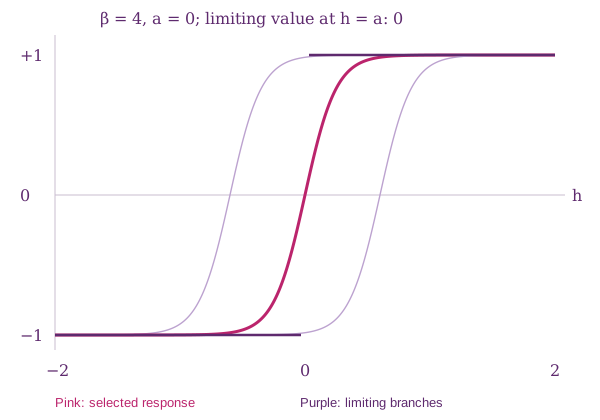
Consider one quantum spin with measured outcomes −1 and +1. In a simple thermal model, their weights are proportional to exp[−β(h − a)] and exp[β(h − a)], respectively. Here h is a field parameter expressed in energy units, a is an offset, and β is the inverse thermal energy. The mean response is
mβ,a(h) = tanh[β(h − a)].
Cooling increases β. Every finite-temperature curve is continuous, but its pointwise limit is −1 below a, +1 above a, and zero at a. At fixed β, varying a gives a pointwise ordered family. The witness is a common field value h. Three ordered curves realize at most four low–high prescriptions at fixed separated thresholds, whereas independence would require all eight.
The course develops the many-spin setting through thermodynamic limits and studies independence for families of quantum responses.
The mathematical route
A route through the mathematics.
Each lecture is one section of the course notes.
-
Topology and probability
Pointwise closures and finite patterns
The Bourgain–Fremlin–Talagrand theorem describes pointwise closures that remain accessible by sequences. VC dimension and the Sauer–Shelah theorem connect restrictions on finite patterns with polynomial growth and probability estimation.
Lectures 1.1–2.2 8 lectures
1. Topology and combinatorics: The Bourgain–Fremlin–Talagrand dichotomy
- 1.1 Independent sequences and pointwise closures
- 1.2 Metrizability from uniform discrepancies
- 1.3 Canonical compacta: Countability and separability
- 1.4 The extended duplicate and the trichotomy
- 1.5 Stability and the order of limits
- 1.6 Games: recovering the value at a limiting input
2. Finite patterns control sampling and subgroup intersections
- 2.1 Counting patterns and controlling empirical error
- 2.2 Finite intersections and independent membership tests
-
Banach geometry and symmetry
Sequences, symmetry, and classical subspaces
Rosenthal’s ℓ₁ theorem separates weakly Cauchy behavior from a classical geometric obstruction. Maurey’s limiting operations reveal how symmetry and algebraic identities detect classical subspaces.
Lectures 3–5.3 15 lectures
3. Analysis and combinatorics: Rosenthal’s ℓ₁ theorem
- 3 Rosenthal’s ℓ₁ theorem
4. Symmetry and classical subspaces: Maurey’s limiting laws
- 4.1 Translated norms and their limiting operations
- 4.2 The calculus of strong types
- 4.3 From a law to a basic sequence
- 4.4 Block limits and symmetric strong types
- 4.5 Extremal strong types and limiting laws
- 4.6 The two characterizations
- 4.7 The bidual form for separable spaces
- 4.8 The hypotheses tested on c₀
- 4.9 Power laws on ℓₚ
- 4.10 Nonsymmetric idempotents
- 4.11 Reflection and symmetry of limiting translations
5. Spreading limits: Increasing selections and permutation symmetry
- 5.1 Coefficient laws and spreading limits
- 5.2 Maurey’s laws and classical coefficient norms
- 5.3 When coefficient order no longer matters
-
Algebra and dynamics
Limits become operations
The Ellis–Numakura lemma supplies an idempotent among the limiting transformations of a compact space. This operation is unchanged by its own repetition, even when ordinary iteration fails to converge.
Lectures 6.1–8.8 19 lectures
6. Idempotent ultrafilters generate finite products
- 6.1 Composition and compact semigroups
- 6.2 Idempotent ultrafilters and finite products
7. Orbit independence distinguishes regularity from entropy
- 7.1 Five classes of cascades
- 7.2 Observations and the regularity of limits
- 7.3 Reading all observations together
- 7.4 Actions of topological groups
- 7.5 One observation at a time
- 7.6 Integer-time actions
- 7.7 Entropy along prescribed times
- 7.8 Orbit independence and entropy
- 7.9 Orbit independence as Banach geometry
8. Asymptotic analysis: Classical Banach spaces through their limiting operations
- 8.1 Topology: the coheir compactum
- 8.2 Dynamics: stability as continuity
- 8.3 Algebra: idempotents and asymptotic growth
- 8.4 The second scale: a family without an action
- 8.5 The criteria on classical spaces and renormings
- 8.6 Summary of the comparison
- 8.7 Entropy and orbit geometry: an outlook
- 8.8 Open entries
-
Quantum measurement
Preparation, measurement, and response
Fix an observable and vary the preparations of two quantum systems. Their expectation values give families of real functions. Convex mixtures then impose restrictions on the compact spaces of limiting responses.
The single-spin response above is the first example of this step.
Lectures 9.1–10.7 12 lectures
9. Quantum responses: Mixtures constrain the limiting space
- 9.1 Preparations, probes and a compact space of observations
- 9.2 Diagonal tests distinguish the two alternatives
- 9.3 Completing the full preparation family
- 9.4 Convexity excludes the split alternative
- 9.5 Mixtures and the three response classes
10. Quantum examples: Finite patterns and limiting response classes
- 10.1 Countable probes distinguish the response topologies
- 10.2 Averaging preserves a finite-pattern bound
- 10.3 Number and position comparisons
- 10.4 Causal order at a fixed detection time
- 10.5 A spin register separates local and uniform independence
- 10.6 Magnetization as a family of response curves
- 10.7 Moving the transition changes the response compactum
-
Numerical computation
One Newton update, two kinds of behavior
The same Newton formula behaves differently on real and complex inputs. A fixed observation excludes independence on the real domain and realizes every finite high–low prescription on selected imaginary inputs.
Lectures 11.1–11.7 7 lectures
11. Divergent iteration still admits limiting operations
- 11.1 Continuous limits and uniform approximation
- 11.2 Composition and idempotence
- 11.3 From compact states to invariant shards
- 11.4 Convergent iteration and discontinuous limits
- 11.5 Rounding and the topology of limiting computations
- 11.6 The Euclidean algorithm: tame but not first countable
- 11.7 Real and complex Newton iteration
Where the route arrives
Model theory: the common language.
Based on the book by Olivia Aubone and José Iovino.
Every translation on this page reads one configuration: the instances of a single formula φ(x, y) whose truth values can be prescribed independently. Shelah isolated this configuration in model theory as the independence property. Its absence, NIP, is the dividing line that the course follows through each subject.
Model theory supplies the grammar that the translations share. It explains why one restriction governs pointwise closures, VC classes, ℓ₁ sequences, tame dynamics, and quantum responses. We develop each subject in its own language and then return to model theory, where the readings become instances of one property of a formula.
The main development assumes no previous course in model theory. Optional readings make the logical connections precise for students familiar with compactness, types, and saturation.